Patrick Sumner—Punnie
The North WaterPatrick Sumner and Punnie’s brief relationship develops during his week with a hunting camp and ends with a small but decisive act of speech. Their intimacy is repeated but largely unspoken: Punnie keeps her distance in the daytime, while Sumner treats their nights as an escape from thought and meaning. When she finally turns toward him and says goodbye, his rejection reveals how strongly he has relied on their silence.
Encounter and Circumstances
Sumner’s stay with the hunters begins in the wake of a successful seal hunt. The size of the animal helps establish his standing in the camp: children gather around him, and people regard him as someone able to assist in bringing animals to the hunters. The scene places him within a community whose language and customs remain unfamiliar to him, even as he participates in its daily life. Punnie’s later closeness takes place within this shared setting, rather than as a separate courtship removed from camp routines.
At night, under the deer hides, Punnie presses close to Sumner. He initially interprets her movement as an adjustment in sleep, then understands it as an invitation. She does not speak or turn toward him, and he responds without trying to begin a conversation. The narration describes this encounter as an experience emptied of further implication for him: he wants to inhabit the immediate physical moment without making it stand for affection, obligation, or a future. This is Sumner’s interpretation of what is happening, not an explanation supplied by Punnie.
A Repeated, Unequal Intimacy
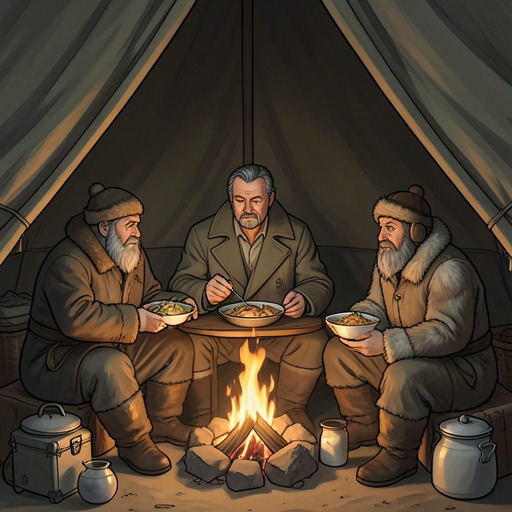
The arrangement continues through the week. Each day the hunters catch another seal; each night Punnie and Sumner are intimate while the others sleep. Punnie keeps her back turned and neither encourages nor resists him in words. In the morning she gives him warm water and raw seal liver, but treats him coolly, without acknowledging the nights. The contrast between private repetition and public reserve defines the relationship: its pattern is consistent, but its meaning is never discussed between them.
Sumner reads that reserve through assumptions he cannot verify. He imagines that Punnie is following a customary politeness and that Urgang, her husband, has encouraged or directed it. The account presents this as Sumner’s supposition, not as confirmed knowledge of Punnie’s wishes or Urgang’s intentions. That uncertainty matters: Sumner accepts what is offered without asking what the arrangement means to her, and the intimacy remains bounded by his own effort to treat it as an encounter without implications.
His response also belongs to a wider withdrawal from the life he left behind. He has not spoken English since leaving the mission, and, as the week ends, he anticipates missing the ice and the unfamiliar speech of the igloo. By contrast, the thought of returning to the priest, with his books, papers, opinions, plans, and doctrines, fills Sumner with irritation and gloom. Punnie’s silence fits into this temporary distance from English conversation and the interpretive frameworks Sumner associates with the mission; the evidence does not show that the two share a language through which they could explain their arrangement.
Goodbye and Rejection
On the final night, Punnie behaves differently after their intimacy: instead of turning away, she faces Sumner. She smiles and tries to speak. At first he hears the words only as unfamiliar sounds; then he recognizes that she is addressing him in a crude but intelligible form of English. Her effort to say “Gud bye” makes their parting explicit for the first time. The change is not a promise of continued closeness, but it is an attempt to make the ending something they can acknowledge together.
Sumner responds by frowning and shaking his head. He feels exposed and ashamed, as though her words have brought their previously private arrangement into view. He whispers, “No more of that. No more.” His answer refuses not the practical fact that he will leave, but Punnie’s attempt to name the separation. The sequence turns on a sharp reversal: the silence that had allowed Sumner to experience the relationship as without further meaning becomes uncomfortable once Punnie breaks it.
Significance in Sumner’s Arc
The farewell reveals a limit in Sumner’s preferred detachment. During the week, he can accept intimacy so long as it remains unspoken and, in his own mind, without consequence. Punnie’s simple use of English disturbs that arrangement by making her presence and the approaching departure harder to leave unacknowledged. His shame and demand for silence show that he is not simply indifferent; he is troubled by the recognition that their encounters have involved another person who can address him and mark their ending.
The relationship closes without reconciliation or a shared account of what it meant. The following day Sumner returns to the mission, where he finds the priest ill and resumes the surroundings he had anticipated with gloom. Punnie’s goodbye therefore remains a brief interruption between the relative vacancy of the hunting camp and the mission’s familiar world of speech and doctrine. Its emotional force comes from its modest scale: an attempted farewell is enough to expose the distance between Sumner’s wish to keep experience unburdened by meaning and another person’s effort to meet him in words.